Choosing permanent underwater lights in 2026 requires more than searching for the highest IP number. A pool light beneath clear water faces constant pressure, chemical exposure, condensation, and repeated thermal changes. Saltwater adds another problem: corrosion can attack housings, screws, cable glands, and connectors long before the LED fails. The practical question is, what ip rating is required for permanent underwater lights?
IEC 60529 defines IP protection against solids and water, but it does not certify every installation condition. For continuously submerged fixtures, IP68 is usually the baseline specification. However, “IP68” has no universal depth or duration. The manufacturer must state the tested immersion conditions. That detail matters. A fitting rated for three metres may not suit a deep decorative fountain or marine dock. IP69K can indicate resistance to powerful hot-water jets, yet it does not automatically prove long-term underwater performance. A small distinction. It is often misunderstood.
Professional guidance should also include IEC 60598-2-18 for swimming-pool and similar luminaires, IEC 60364-7-702 for pool installations, and applicable UL requirements in North America. These references address more than water ingress. They support safer choices involving isolation, bonding, cable routing, and installation zones. Grand View Research’s LED lighting market analysis highlights durability and lifecycle efficiency as major adoption drivers. That finding is useful, but market reports cannot replace product testing. Real projects still need verified seals, corrosion-resistant materials, compatible transformers, and documented depth ratings. IP68 is a starting point, not a complete answer. Even experienced installers sometimes overlook the cable entry.
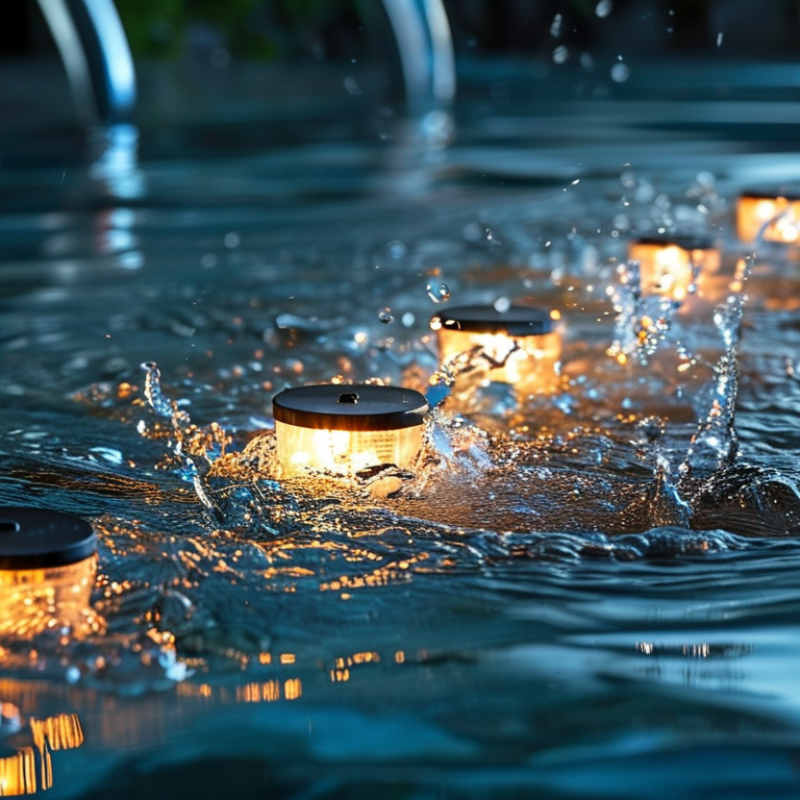
Permanent underwater lights are fixed lighting units installed in pools, fountains, docks, or submerged architectural features. Unlike floating lamps, they stay mounted in one position and connect to a protected power system. Their purpose is steady illumination, not temporary decoration.
Most modern units use LEDs because they produce strong light with limited energy consumption. Electricity reaches the fixture through a low-voltage transformer and a sealed cable connection. Inside the housing, the LED creates light, while the surrounding water helps remove heat. A durable housing protects the circuit from pressure, moisture, and impact. Glass or engineered lenses spread the beam across the water.
The IP rating describes protection against solids and water. For permanent underwater installation, IP68 is commonly selected because it supports continuous submersion under stated conditions. IP67 usually covers temporary immersion, so it may not suit a light that remains underwater. The exact depth and duration still depend on the manufacturer’s test conditions. IP68 is not a complete safety answer.
Saltwater, chlorine, cleaning chemicals, and poor cable joints can still cause failure. A careful inspection should check seals, cable glands, mounting screws, and signs of corrosion. The cable entry is often the weak point. I would not judge a fixture by its rating alone, because real installations are less perfect than laboratory tests. Positioning also affects glare, beam spread, and maintenance access. A light can be waterproof yet poorly placed.
IP68 is usually the best starting point. It supports continuous immersion under specified test conditions. Depth still matters. A light tested at two metres may not suit five metres. Check the documented depth and immersion time.
No. IP68 only describes tested dust and water protection. It does not guarantee resistance to chlorine, salt, pressure, or poor installation. The cable entry, connector, gasket, and junction box need suitable protection too.
IP67 generally covers temporary immersion. IP68 covers continuous immersion under stated conditions. Permanent underwater fixtures usually need IP68. Always confirm the manufacturer’s actual test limits.
Not necessarily. IP69K mainly concerns high-pressure, high-temperature washing. It does not automatically prove suitability for deep, continuous immersion. The rating sounds stronger, but the application differs.
Check the housing, cable gland, connector, lens joint, gasket, and mounting seal. Look for cracks, cuts, or loose fittings. One small gasket cut can admit water. Check the tested depth as well.
Follow local electrical rules and the installation instructions. Use qualified electrical help for circuit protection and bonding. Keep connections above the waterline when practical. Use sealed enclosures and drip loops. Avoid tight cable tension.
Yes. Saltwater can accelerate corrosion, even when water-entry protection is excellent. Use corrosion-resistant materials, suitable cable jackets, stainless hardware, and sealed connections. Inspect fasteners for dull surfaces or rust stains.
Switch off power before inspection. Check the lens, cable jacket, seals, fasteners, and visible corrosion. Remove mineral deposits gently. Do not pressure-wash the fixture. Replace damaged gaskets early. That is usually cheaper.
No. I once treated IP68 as a complete safety guarantee. That assumption was too simple. Record inspection dates, water depth, faults, and repairs. Good records reveal repeated problems that memory misses.
Permanent underwater lights are purpose-built fixtures designed to operate continuously in pools, fountains, docks, ponds, and other submerged environments. They use sealed housings, waterproof cable entries, and corrosion-resistant materials to protect internal electrical components while directing light through the water. When choosing equipment, the key question is: what ip rating is required for permanent underwater lights? In most fully submerged applications, a high IP rating, such as IP68, is preferred because it provides strong protection against dust and prolonged water immersion. However, the exact requirement should match the installation depth, exposure conditions, and local electrical standards.
IP protection is only one part of reliable performance. Light output, beam angle, color temperature, heat control, material durability, cable quality, and compatibility with the power supply also matter. Professional installation should include correct sealing, safe low-voltage connections where appropriate, secure mounting, and proper cable routing. Regular maintenance should involve checking seals, lenses, connectors, and signs of corrosion or water entry, helping preserve brightness, safety, and service life.

